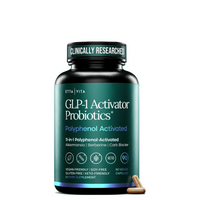
A functional GLP-1 supplement works by supporting the gut conditions your body already uses to produce this metabolic hormone. Most products in this category share similar ingredient vocabulary but fail at the point where effectiveness is actually determined: whether the active components survive long enough to reach the intestinal sites where the mechanism lives.
Key Takeaways
- GLP-1 supplements don't deliver the hormone directly; they support the gut environment that drives your body's own production
- Whether ingredients reach their target sites in viable condition is what separates functional formulations from expensive label claims
- Third-party product testing as part of quality assurance is the meaningful standard; general "quality tested" language on a product page is not
- Supporting natural GLP-1 production is an incremental biological process with a timeline measured in weeks, not days
- Asking three specific questions before choosing any GLP-1 supplement will tell you more than reading the ingredient list ever will
Why Most GLP-1 Supplements Fall Short Before They Even Start Working
The science behind GLP-1 supplementation is legitimate. Glucagon-like peptide-1 is a metabolic hormone your intestinal lining is built to produce. Specific cell populations secrete it in response to microbial signals, fermentable fiber, and the broader gut environment it finds itself in. It plays a recognized role in appetite regulation, gastric emptying, and blood sugar signaling.
The concept isn't where products fail. What fails is the journey from capsule to intestinal lining.
A probiotic strain that can't survive stomach acid won't reach the sites where it stimulates GLP-1 secretion. A botanical extract with poor systemic absorption gets processed before it can influence gut-brain signaling. The label shows a compelling ingredient. The body never meaningfully encounters it. That gap between what's printed and what's delivered is where most products quietly stop working.
Brands know consumers buy on ingredient recognition. So formulations get built around ingredient names people already associate with gut health, not around the question of whether those ingredients can reach their destination in a condition to do anything useful. The result is a category full of products that read well on a label and underperform in the body.
Before choosing any supplement, it's worth understanding how your body's natural GLP-1 pathways actually function, because knowing the mechanism makes it much easier to evaluate whether a product was designed around it. Etta Vita's GLP-1 Activator Probiotics is formulated specifically around that mechanism, not around ingredient recognition.
How Is Supporting GLP-1 Naturally Different from a Prescription Drug?
Pharmaceutical GLP-1 receptor agonists and gut-supportive supplements work through entirely different mechanisms and deserve to be kept in separate categories.
Prescription receptor agonists bind directly to GLP-1 receptors, activating the pathway artificially rather than supporting your body's own hormone production. They're fast-acting, prescription-only, and carry a documented side effect profile that's specific to that pharmacological approach.
GLP-1 activating supplements work further upstream. Specific probiotic strains stimulate the intestinal cell activity that drives GLP-1 secretion. Fermentable compounds shift microbiome composition in ways that promote that secretion over time. The effect is incremental and biological rather than immediate and pharmaceutical, and that's not a shortcoming. It's a different category of intervention.
GLP-1 isn't a hormone you supplement directly. It's one your gut is already designed to produce when conditions support it. A well-formulated supplement works to restore and reinforce that process, not override it.
If your goal is the rapid appetite suppression associated with a pharmaceutical injection, a supplement isn't the right tool and no honest formulator will tell you otherwise. If your goal is rebuilding the gut environment that supports more consistent metabolic signaling over time, that's precisely the mechanism a well-formulated supplement addresses.
Three Questions That Tell You More Than the Ingredient List
Most consumers evaluate supplements by reading the ingredient panel. That's understandable, but it answers the wrong question. The label tells you what's in the capsule. It doesn't tell you whether what's in the capsule reaches the body.
Three questions cut through the label noise more reliably.
Does the product name specific strains rather than a probiotic category? Not all probiotic strains influence GLP-1 pathways. The ones that do have a documented mechanism: they stimulate relevant intestinal cell activity or drive short-chain fatty acid production that signals GLP-1 release. A label listing "probiotic blend" without identifying which strains or explaining why they were selected tells you the formulation was built around marketing recognition, not mechanism.
Does the product address how active ingredients survive stomach acid? Strain selection for acid resistance, formulation architecture, and careful manufacturing decisions each play a role here. A product should have a clear answer to this question. If it doesn't address it at all, the most likely explanation is that it hasn't solved it.
Can you evaluate the quality assurance behind a specific product? A brand that incorporates third-party product testing into its quality assurance practices gives you something more meaningful than a generic "tested for quality" badge. The difference between documented quality verification and self-assessed marketing language is the most reliable signal that a brand has thought carefully about what it's asking you to put in your body. Etta Vita incorporates third-party product testing into its quality assurance practices, with testing procedures that may vary by product and production batch and some safety testing conducted at the supplier level.
What Verified Formulation Actually Looks Like in Practice
Consider how this plays out in a common scenario. Someone starts two gut-targeted supplements at the same time. Both have compelling labels and similar price points. One specifies strains selected for intestinal cell stimulation and is built around bioavailability at every stage of formulation. The other lists a "proprietary probiotic complex," names no strains, and provides no information about how the active components are protected during transit through the digestive tract.
Several weeks in, any difference in gut environment these two products create won't trace back to the ingredient concept. It'll trace back to whether the active components reached their target sites in viable condition. That's a delivery question, and it's the one most brands in this category quietly avoid answering.
Etta Vita's formulations targeting the gut-brain axis are built around strain specificity and bioavailability, not broad-spectrum coverage. There's a real difference between a product designed for general digestive support and one where every included component has a documented role in the specific pathway being targeted. You can explore the full product collection and review what's been formulated for metabolic and gut-health support.
Verified Formulation vs. Label Faith: What You're Actually Choosing Between
| What You're Evaluating | Unverified Product, No Quality Documentation | Formulation with Third-Party Testing and Quality Assurance |
|---|---|---|
| Strain specificity | "Probiotic blend," strains unnamed | Strains selected for documented pathway relevance |
| Delivery architecture | Standard capsule, no bioavailability detail | Formulated around bioavailability and deliverability |
| Third-party verification | Brand's own quality language | Third-party product testing as part of quality assurance |
| Batch traceability | General quality assurance, no documentation | Quality assurance practices with testing oversight |
| Ingredient sourcing | Rarely disclosed | Transparent, purity-focused sourcing |
| Shipping cost | Variable, often additional | Free delivery on all orders |
| Customer support | Standard hours or email-only | Customer support available seven days a week |
The comparison worth making isn't between a premium product and a cheaper one. It's between a product whose formulation you can evaluate with confidence and one whose label you're accepting on faith. A product that fails to survive the digestive tract costs more in every meaningful sense regardless of what you paid for it, because the mechanism never reached the body.
What Realistic Outcomes Look Like
Supporting natural GLP-1 production through gut-targeted supplementation isn't a fast-acting intervention. You're building a biological environment, and that takes weeks, not days.
In a typical scenario, someone pairing a gut-targeted probiotic protocol with dietary choices that support microbiome diversity might begin noticing more consistent appetite signaling over several weeks of consistent use. Any shift in metabolic regulation, if it occurs, follows microbiome changes that take comparable time to establish. These are the kinds of outcomes that can develop with a well-formulated product used consistently within a supportive dietary context. They're not guaranteed, and there's no precise universal timeline.
What you shouldn't expect: the appetite-suppression speed of a pharmaceutical GLP-1 drug. That's a different mechanism producing a different effect by design.
What a verified, well-formulated product can reasonably support: an improved gut environment, more consistent metabolic signaling over time, and a foundation that works with your body's own regulatory processes rather than around them. The Etta Vita health guides go into further detail on realistic timelines across different wellness goals.
Who This Fits, and Where It Doesn't
GLP-1 supporting supplements aren't a substitute for medical treatment of type 2 diabetes, clinically significant obesity, or any condition your physician is actively managing. If you're currently taking a prescription GLP-1 receptor agonist, adding any supplement to that protocol is a conversation for your prescribing doctor first.
This approach also won't fit someone expecting pharmaceutical-speed results from a biological process. The mechanism is real and the science is sound, but the timeline is incremental by design.
And if supplementation isn't paired with any dietary attention at all, results will be limited. The gut environment that produces GLP-1 responds to what you eat. A supplement supports that environment; it doesn't override the inputs.
If you're health-conscious, interested in metabolic support, and willing to think about supplementation as a sustained biological investment rather than a quick fix, this is a well-grounded starting point.You can browse Etta Vita's formulations and review the available product information before committing to anything. That level of visibility into what you're actually taking is what this category has been missing. Etta Vita's commitment to transparency and its founding mission informs its approach to product development and quality assurance.
Frequently Asked Questions
How is a GLP-1 supplement different from an injection like semaglutide?
GLP-1 injections are prescription receptor agonists that activate GLP-1 receptors directly, bypassing your body's own hormone production entirely. GLP-1 supporting supplements work upstream, reinforcing the gut conditions under which your body produces the hormone through its own biology. They're different mechanisms with different timelines, different risk profiles, and different goals.
How long before a gut-targeted GLP-1 supplement might show any effect?
Gut microbiome shifts that influence GLP-1 production take time to establish. Someone who responds well to this kind of supplementation might begin noticing changes in appetite consistency or digestive regularity over several weeks of consistent use. Consistency matters considerably more than increasing the dose early.
Can I take a GLP-1 supplement if I'm already on a prescription GLP-1 medication?
That's a question for your prescribing physician. Interaction effects on your specific protocol require clinical evaluation. Don't assume it's safe or problematic without that conversation.
What separates a GLP-1 targeted formulation from a standard probiotic?
Standard probiotics are formulated for general digestive support, which is a broad and non-specific goal. A GLP-1 targeted formulation is built around specific strains chosen for their documented role in intestinal cell stimulation and gut-brain axis signaling. That specificity, combined with formulation decisions designed to support bioavailability, is what distinguishes it from a general gut health product.
How do I know what's in the capsule actually matches what's on the label?
Etta Vita incorporates third-party product testing into its quality assurance practices. Testing procedures may vary by product and production batch, with some safety testing conducted at the supplier level. That's a meaningfully higher standard than general "tested for quality" language on a product page, and it reflects a commitment to verified formulation rather than brand self-assessment.
Is this relevant if I'm just starting to pay attention to gut health?
Yes. You don't need an existing gut health protocol for a gut-targeted GLP-1 supplement to be relevant. If you're interested in metabolic support, more consistent appetite signaling, or building a foundation for long-term gut health, this is a well-grounded starting point. Pairing it with dietary choices that support microbiome diversity will strengthen your results over time.
Does Etta Vita offer support if I have questions about using the product?
Yes. Etta Vita offers free delivery on all orders, and customer support is available seven days a week. If you have questions about timing, how to integrate a product with your existing routine, or what to expect over the first several weeks, the support team is available to help. You can also reach out directly through the Etta Vita contact page with specific questions.